My broker management system knows everything about my clients. Except what I want to achieve.
Over the past few months I have seen a lot of broking firms from the inside: in demos, at trade fairs, in long conversations with owners. Almost everywhere the picture is the same. The broker management system is an excellent archive. It knows which client holds which policy, when the next renewal is due and which documents last arrived from the insurers. It answers reliably, but only when someone asks.
The real work happens elsewhere: in the broker's head. Which lines should grow? Which clients are underinsured? Which quote falls short of the standard the firm promises its clients? These questions are almost always answered by a person, often under time pressure and rarely systematically.
Every broker knows the result: books that are administered but not developed. Cross-selling that depends on chance. Advice quality that depends on who happens to pick up the phone.
A broker evaluating new software for a larger broking group put it to me like this in a demo: his firm is stuck in the dilemma of entering data by hand just to get any result at all. When we moved on to AI analysis, his most important question came straight away: how does the system know what we always want included, if we never tell it?
Strategy belongs in the system
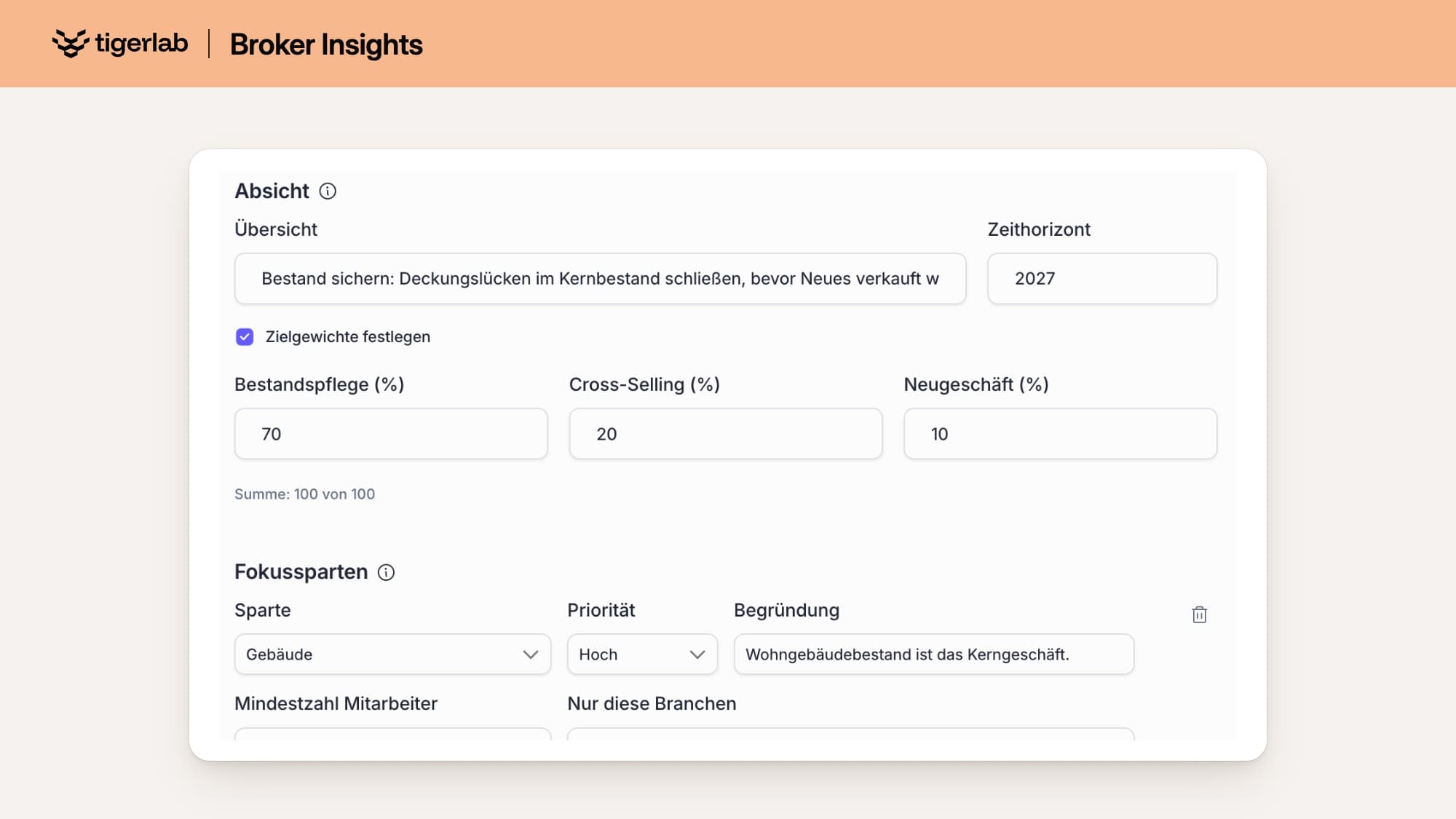
My view: a modern broker management system has to know the firm's strategy. Not a generic industry strategy, but its own. Which lines are in focus, where does the firm want to grow, which new business is it actively looking for?
A commercial broker specialising in transport and logistics has different goals from a broker serving small trades businesses. A firm that wants to grow in cyber needs different prompts from one that wants to make its motor book more profitable.
Once the strategy is in the system, the system's role changes. It no longer just administers, it works alongside the team. AI makes this practical for the first time: it checks books, policy documents and quotes against the firm's goals continuously, at a scale no team could manage by hand.
Three everyday examples
Spotting coverage gaps before the client asks. The system compares a commercial client's policies with its risk profile and the firm's focus lines. If a haulier with growing international business lacks the right freight liability cover, the account handler sees the prompt before the claim happens.
Checking quotes against the firm's own house standard. Many firms have a quality bar that is written down nowhere. Once it is in the system, every quote is measured against it automatically: where it exceeds the standard, where it falls short, and how it compares with the market.
Targeting new business. If a firm wants to grow in a sector, the system flags existing clients with relevant connections, room to extend cover or upcoming renewals. A list of due dates becomes a prioritised list of opportunities.
The system delivers the right information at the right time. The broker makes the decision.

tigerlab brokerage (demo data): for a machine builder with export business, the system names three missing covers, each with its reasoning, its link to the firm's strategy and a concrete next step. Whether a prompt is acted on, deferred or dismissed is the account handler's call.
Why now
Talent shortage. If the team can't grow, the system has to take on more of the thinking.
Succession. In many firms, knowledge about clients and strategy lives in the owners' heads. A strategy recorded in the system makes the book transferable, and so more valuable.
Duty of advice. The Insurance Distribution Directive (IDD) requires advice that fits the client's needs, and documentation of it. A systematic check for coverage gaps strengthens both.
The fair objections
"I'm not going to let software tell me what to do." I hear this a lot, and it's fair. That's why the distinction matters: the system doesn't impose someone else's strategy. It carries out the strategy the firm set for itself, and it suggests rather than decides.
Data protection. Anyone analysing client books with AI needs clear rules on where the data is processed, who has access and on what legal basis. Data held in the EU, traceable analyses and clear deletion policies are prerequisites, not extras.
AI makes mistakes. A coverage gap prompt can be wrong, for example because information is missing from the records. Good systems therefore always show what a prompt is based on, so the broker can check it in seconds.
How we approach this at tigerlab
This is exactly the approach behind tigerlab brokerage, our broker management system. The firm's strategy isn't a side topic there, it is the starting point: focus lines, house standard and growth targets are recorded, and the platform works against them continuously. It is in use in more than 30 countries today.
Conclusion
The next generation of broker software won't be judged by how much data it stores, but by whether it helps brokers reach their goals. That takes firms that state their strategy clearly, and systems that turn it into daily work.
The technology is here. The question is which firms take the step first.
If you'd like to see what this would look like with your own book, I'm happy to show you in a short demo.
About the author
Holm Schimanski is Partner and Chief AI Product Officer at tigerlab. He has worked in B2B enterprise software for more than 21 years and is responsible for tigerlab brokerage, a broker management system in use in more than 30 countries.