When anyone can be a broker: why your own know-how is the new competitive edge
Market knowledge about covers and wordings is available to everyone today, and AI makes it even more accessible. An insurance broker's edge therefore lies in their own structured know-how. A modern broker management system has to capture that knowledge and bring it into every AI-assisted analysis.
The market's knowledge belongs to everyone
In a recent conversation, a broker said something that stuck: with today's tendering and comparison tools, pretty much anyone can open a brokerage. If you have access to extracted wordings and cover overviews, you don't need to understand much about insurance to put quotes side by side.
That is an overstatement, but it makes a point. Standard policy wordings, model clauses and cover comparisons are well documented. AI can already read, structure and compare quotes. For a large share of clients, that standard is enough.
What really sets brokers apart
Good brokers know more than the standard. Over the years they have learned which points always need checking in certain industries. They know individual insurers' special terms. Some have defined their own cover building blocks that they ask for in every tender.
This knowledge is the real value of a brokerage. It is why clients go to a particular broker and not to the cheapest comparison site.
The problem: the knowledge doesn't work along
In many brokerages, this know-how sits in the heads of experienced staff, in checklists, spreadsheets or older systems it can't be exported from. Classic CRM systems need a lot of manual upkeep and map processes only with effort.
The result: when AI compares quotes or reviews a book of business, it compares against what is in the quote or against general market knowledge. What matters to the broker is missing.
The decisive question: what truth does the AI check against?
The question is no longer whether AI can compare quotes. The question is what truth sits behind it. That takes two layers:
- Market knowledge: what do insurers generally offer in a line of business?
- Your own knowledge: what does our house expect on top, by line and by industry?
Only when both layers are in the system can AI assess a client the way an experienced broker would, and point out gaps that don't appear in any quote.
How tigerlab brokerage handles it
tigerlab brokerage is a broker management system with AI at its core. A brokerage's own knowledge sits there on two layers.
Guidance describes how your house handles a case: for the whole workspace or for a single line of business, and if needed only for one country or topic. An example: for cyber, the client completes the insurer's proposal form before every tender, because without details on backups, MFA and patch management there are no reliable quotes.

A guidance item for the cyber line: where it applies and what it says. The system also counts how often the AI offered and cited it in analyses.
Strategies set what takes priority, for example whether this year is about retention or new business, and which lines are in focus. A strategy changes the weighting and the reasoning. It never hides a gap.
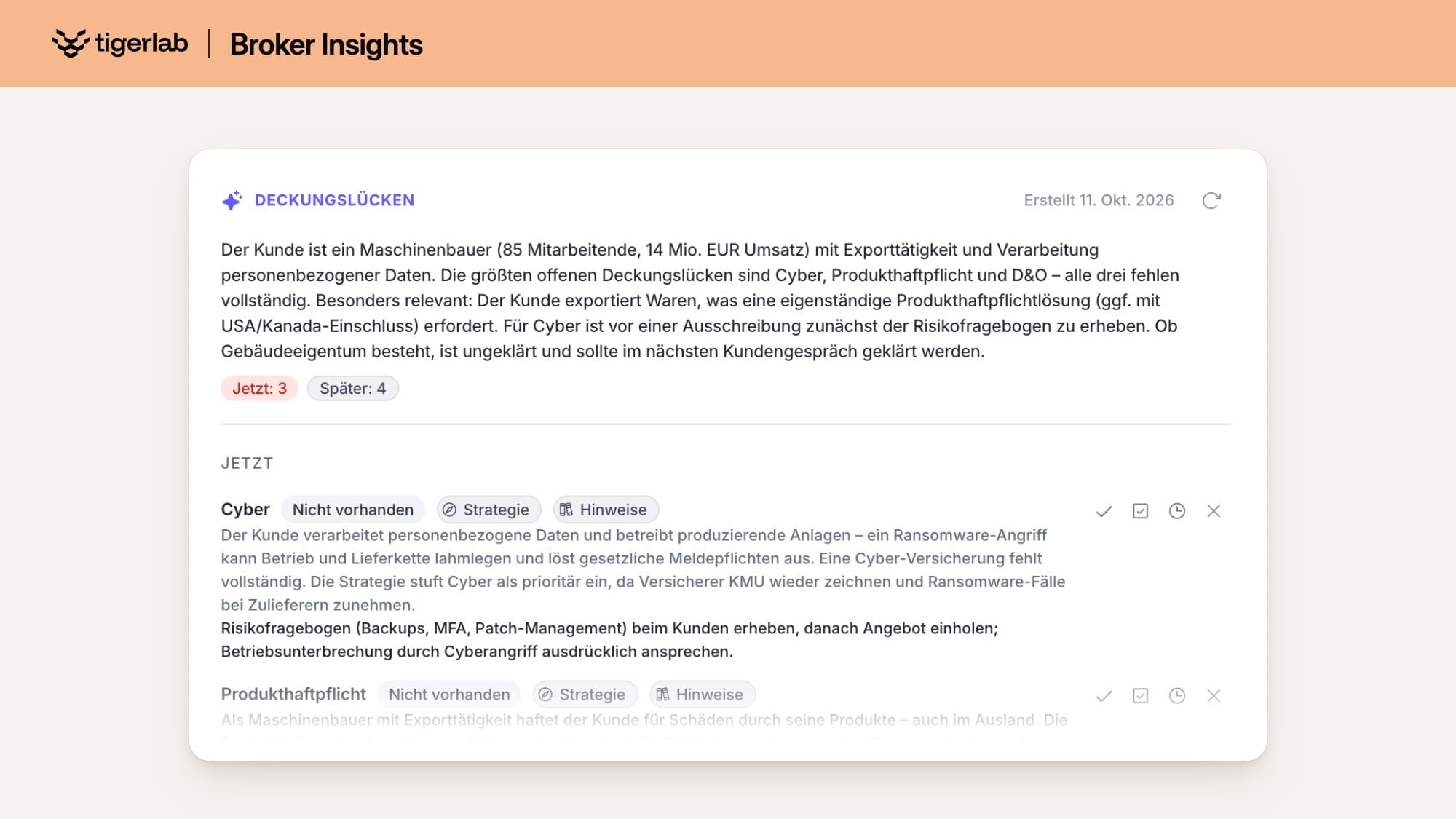
Both feed into the coverage gap analysis for a client today. The AI shows openly where it used the strategy and where it used one of the house's guidance items. So the broker sees not only that a gap exists, but also by whose standard it was assessed.

Coverage gaps for a machine builder (demo data). The cyber recommendation follows the house's guidance: proposal form first, then quotes.
This turns the know-how of individual staff into knowledge that works across the whole house, and that stays with the broker.
Conclusion
Market knowledge is becoming basic equipment. What will set brokers apart is their own knowledge, and whether it works inside the system or stays in heads and files. Brokers who bring their know-how into the system in a structured way turn AI into their amplifier. Everyone else turns it into their competition.
Frequently asked questions
What is the difference between market knowledge and your own know-how? Market knowledge is what insurers generally offer and what is documented in wordings and comparisons. Your own know-how is what a brokerage expects and checks beyond that, such as specific questions by industry or negotiated special terms.
How does a brokerage get its knowledge into the system? Ideally as short, clear guidance items per line of business: what is always checked, in what order and why. To start with, the lines with the largest share of the book are enough.
Does the AI replace advice? No. The analysis supports decisions. Advice and the decision stay with the broker.
Does the knowledge stay with the broker? Yes. The guidance belongs to the brokerage and applies only in its own workspace.
About the author
Holm Schimanski is Partner and Chief AI Product Officer at tigerlab. He has worked in B2B enterprise software for more than 21 years and is responsible for tigerlab brokerage, a broker management system in use in more than 30 countries.