Why do AI pilots fail in insurance? It's almost never the AI.
95% of enterprise generative AI pilots delivered no measurable P&L impact (MIT NANDA, 2025). The tools are not the problem. The foundation underneath them is.
If you have looked at any insurtech roadmap this year, you will see AI dominating the conversation. Everyone wants to automate submissions, generate instant underwriting insights, and cut the hours lost to manual data entry.
But a quiet reality is setting in across the market: you cannot bolt a 2026 AI agent onto a 2010 legacy system. Gartner predicts that through 2026, organisations will abandon 60% of AI projects that are not supported by AI-ready data.
To get AI-ready, MGAs and brokers need to fundamentally change how they handle data. Here is what that looks like from both the boardroom and the server room.
The Business Reality (for CEOs and Founders)
The appeal of AI is obvious: lower operational costs, faster response times, and the ability to outscale competitors without doubling headcount. But buying an off-the-shelf AI wrapper and plugging it into an ageing legacy system is an expensive trap.
What is sitting in your data graveyard?
Industry analysts estimate that up to 80% of enterprise data is unstructured (Gartner, IDC). In a brokerage, that is where your most valuable intelligence lives: in loss run PDFs, email threads, disconnected carrier portals, and Excel bordereaux. It is data you own but cannot easily query, structure, or feed to a model.
When you push this fragmented, dirty data into an AI model, the technology fails. It hallucinates, makes incorrect risk assessments, and forces your team to step in and manually reconcile errors. That defeats the entire purpose of operational automation.
There is also a newer cost that most teams have not yet priced in. As AI agents start quoting and comparing policies on behalf of customers, they need real-time API access to your rating, rules, and binding capability. If your system cannot expose those functions through modern APIs, you are simply invisible to the AI distribution layer.
This is why the gap is widening between AI-first MGAs and the ones still running disconnected pilots. Tech transformation is no longer an IT line item. It is your primary growth strategy. The firms that win in the next five years are not the ones buying the flashiest tools. They are the ones who first fixed their data foundation.
The Architectural Blueprint (for CTOs and IT directors)
The mandate from the top is often: "Implement AI to streamline operations." But as an architect, you know standard relational databases and monolithic legacy systems are structurally hostile to modern LLMs.
Why do legacy databases break under AI load?
Legacy architectures rely on batch processing. They ingest and export data on a schedule, such as nightly flat files. AI agents require real-time context. If an LLM is evaluating a complex commercial submission, it cannot wait for a midnight database sync to learn that a carrier appetite has changed or a specific compliance rule applies.
Legacy vs. AI-ready architecture:
The API-First Mandate
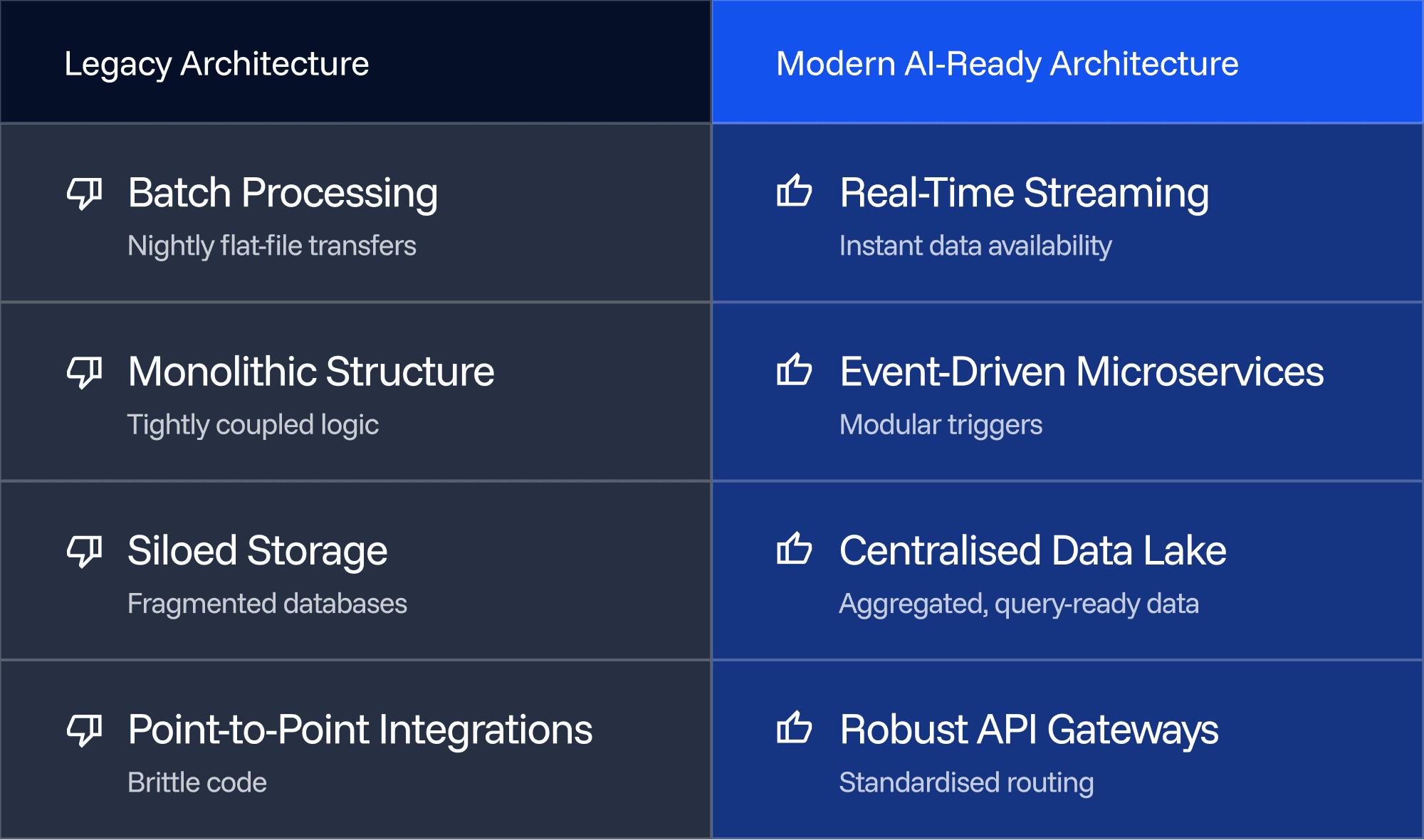
To move past pilot purgatory, insurtech legacy modernisation has to focus on event-driven architecture for MGAs.
Instead of a system sitting idle until a user queries it, an event-driven system reacts instantly. An email with a submission PDF arrives; it triggers a webhook; an API gateway routes the document to a parser, which structures the data and feeds it to the central data lake; the AI model is alerted to begin underwriting analysis.
This requires clean RESTful APIs, strict data governance, and a complete departure from spaghetti-code integrations.
Moving from Legacy to AI-Ready
We have spent the last year speaking with MGAs and brokers who are exhausted by the friction between their AI ambitions and the realities of their legacy systems.
One of our clients saw it directly: in the period following implementation, quotes rose 59% and purchases 67%, with conversion continuing to improve even as volumes climbed. More activity, more conversions, and an architecture that held steady under all of it.
That friction is where we saw room to innovate. tigerlab has spent years building API-first insurtech systems with robust data structuring and real-time processing, and the new BMS, launched in March, is where we married that experience with a new generation of AI technology. It is a genuinely API-first environment with centralised data structuring and real-time event processing, built to handle the heavy lifting of data readiness.
We fix the foundation, so you can actually scale.
Your Next Step
Before investing in another AI wrapper, take a hard look at your infrastructure. Can your system stream real-time context, or is your data still trapped in silos and batch-processing cycles?


